
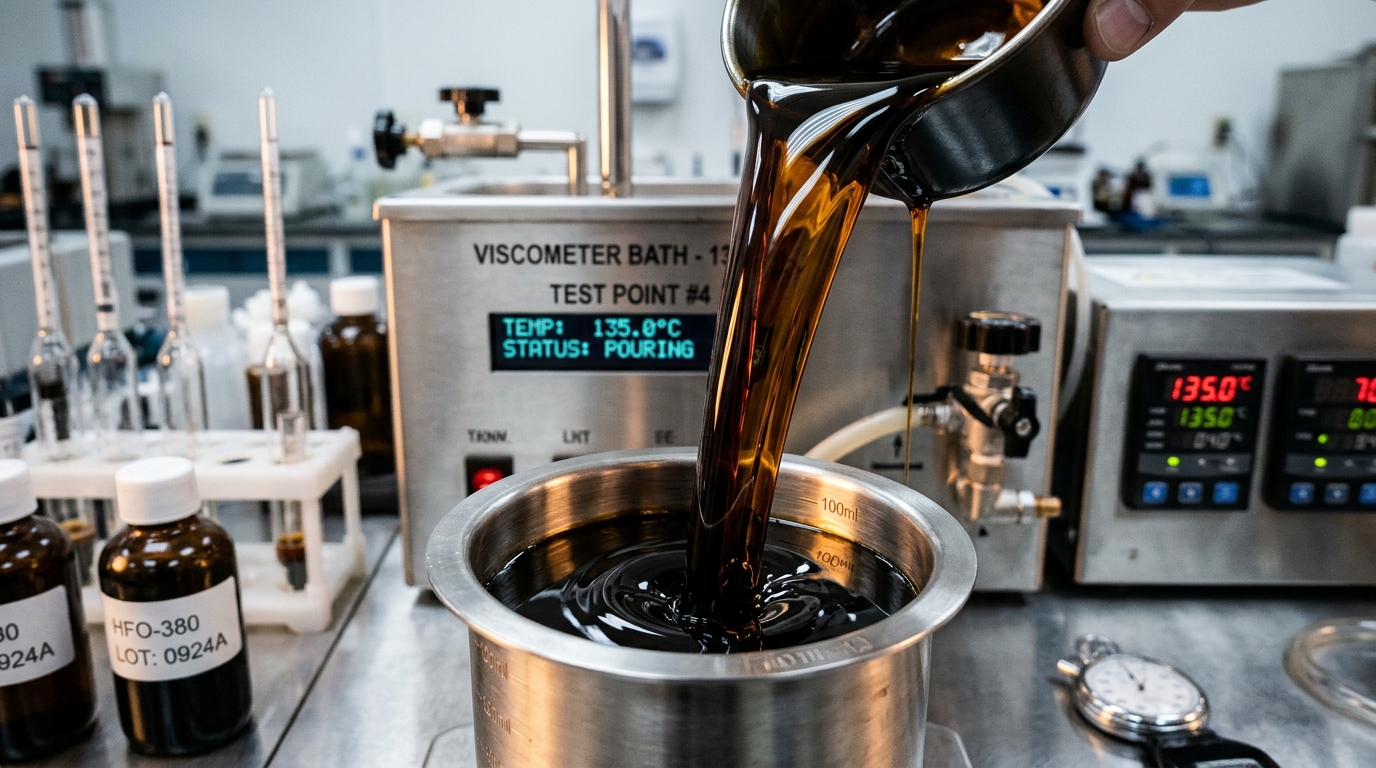
High Sulphur Fuel Oil (HSFO)
Heavy Industrial Residual Fuel Oil · High Calorific Energy Output
High Sulphur Fuel Oil (HSFO / CST 180 & CST 380) for thermal power, industrial furnaces, boilers, and marine bunkering with scrubber systems.
- Kinematic Viscosity @ 50°C
- 180 – 380 cSt
- Gross Calorific Value (GCV)
- ≥ 10,200 kcal/kg
- Flash Point (PMCC)
- ≥ 66 °C
- Sulphur Content
- ≤ 3.50 % wt
Standard industrial grades CST 180 & CST 380 (ISO 3104)
Maximum thermal energy density for industrial combustion
Safe storage and pre-heating threshold (ISO 2719)
High sulphur residual fuel for permitted scrubbed installations (ISO 8754)
THERMAL COMBUSTION PROFILE
Cost-Effective High-Energy Residual Fuel for Permitted Industrial Facilities
High Sulphur Fuel Oil (HSFO) is a dense, high-viscosity residual fuel oil produced from atmospheric and vacuum distillation bottoms of petroleum refining. With a gross calorific value exceeding 10,200 kcal/kg, it represents one of the most energy-dense and cost-effective thermal fuels available for heavy industrial combustion.
Commonly classified by viscosity grades—primarily CST 180 and CST 380—HSFO is utilized in large-scale industrial steam boilers, metallurgical reheating furnaces, glass melting tanks, and marine propulsion plants equipped with approved flue-gas desulphurization (EGCS / scrubber) units.
Global Oil Corporation supplies virgin refinery-sourced HSFO meeting IS 1593 Grade LV / MV and ISO 8217 RMG/RMK standards. Our Vadodara desk coordinates full tank truck and coastal barge consignments with verified density, viscosity, water content, and sulphur certificates.
IS 1593 / ISO 8217 Specification
Verified CST 180 & CST 380 viscosity grades
Maximized Calorific Value
GCV ≥ 10,200 kcal/kg ensures high steam generation efficiency per rupee of fuel cost.
Clean Combustion Profile
Low ash (≤ 0.10%) and low sediment minimize boiler tube fouling and burner tip wear.
Pan-India Logistics
Supplied in insulated road tankers from western coastal terminals and domestic refineries.
TECHNICAL SPECIFICATIONS
Technical Benchmarks & Certified ASTM Standards
Certified parameters for industrial boilers and marine combustion:
| Technical Parameter | Test Standard | Typical Specification | Unit | Significance |
|---|---|---|---|---|
| Kinematic Viscosity @ 50°C | ISO 3104 / ASTM D445 | 180.0 – 380.0 | cSt | Determines pre-heating temperature required for optimal burner atomization |
| Density @ 15°C | ISO 3675 / ASTM D1298 | 0.960 – 0.991 | g/cm³ | Crucial for fuel centrifugal purification and accurate volumetric custody transfer |
| Flash Point (Pensky-Martens) | ISO 2719 / ASTM D93 | ≥ 66.0 | °C | Complies with SOLAS and Indian statutory fire safety storage mandates |
| Pour Point | ISO 3016 / ASTM D97 | ≤ 24 | °C | Defines minimum tank heating coil temperatures during winter storage |
| Total Sulphur Content | ISO 8754 / ASTM D4294 | ≤ 3.50 | % wt | Must conform to regional air quality permits or marine scrubber operation |
| Water Content | ISO 3733 / ASTM D95 | ≤ 0.50 | % vol | Low water prevents flame instability, boiler pulsation, and corrosion |
| Ash Content | ISO 6245 / ASTM D482 | ≤ 0.10 | % wt | Minimizes refractory damage and particulate emission loading |
| Gross Calorific Value (GCV) | ASTM D240 / IS 1448 | ≥ 10,200 | kcal/kg | Primary commercial value metric determining heating efficiency |
INDUSTRIAL FORMULATION
Industrial Combustion Applications
Engineered for heavy continuous-combustion thermal plants:
Industrial Steam Boilers & Captive Power
High-output fuel for water-tube and smoke-tube industrial boilers delivering consistent superheated steam.
Primary Heavy Thermal Fuel
Metallurgical Furnaces & Reheating
Direct firing in billet reheating furnaces and copper smelting vessels where luminous flame radiation is required.
High-Luminosity Firing
Glass Melting & Ceramic Kilns
Provides high-intensity radiant flame patterns essential for deep pool glass melting.
Radiant Flame Firing
Marine Propulsion with Scrubbers
Bunkered by oceangoing vessels equipped with certified exhaust gas cleaning systems (EGCS).
Heavy Marine Bunker Fuel
SUPPLY & PACKAGING
Supply & Delivery Infrastructure
Dispatched in dedicated insulated tank trucks from Kandla, Mundra, and Dahej terminals:
Insulated Heavy Road Tankers
Direct discharge into heated factory heavy fuel oil day-tanks
Barge Consignments (Coastal)
Bunkering and coastal industrial plants with direct jetty discharge facilities
- Store in tanks equipped with low-pressure steam coils maintaining fuel at 45–50°C for pumping.
- Burner atomization requires pre-heating to 105–125°C to achieve optimal firing viscosity (12–15 cSt).
Pan-India Despatch Network
Vadodara Commercial Desk · Deliveries coordinated to Kandla, Mundra, Nhava Sheva, and inland industrial hubs nationwide.
TECHNICAL VERIFICATION & TRACEABILITY
Documentation Coordinated on Every Consignment
Industrial material qualification requires rigorous batch traceability. Every commercial consignment is backed by a verified 4-tier documentation package.
Certificate of Analysis
Refinery testing laboratory report for the loading batch detailing verified physical and chemical properties.
Technical Data Sheet
Guaranteed parameter envelope, ASTM/IS test methods, and technical processing guidelines.
Safety Data Sheet
Mandatory 16-section chemical safety dossier covering hazard classifications, exposure, and PPE.
Logistics Clearance
Complete shipping manifest, road transit permits, weighbridge slips, and customs clearance paperwork.
High Sulphur Fuel Oil — Laboratory Summary
Representative specification parameters coordinated on current HSFO supply consignments.
| Parameter | Test Method | Specification Range | Unit |
|---|---|---|---|
| Kinematic Viscosity @ 50°C | ISO 3104 | 180 – 380 | cSt |
| Gross Calorific Value | ASTM D240 | ≥ 10,200 | kcal/kg |
| Total Sulphur | ISO 8754 | ≤ 3.50 | % wt |
| Flash Point (PMCC) | ISO 2719 | ≥ 66 | °C |
| Water Content | ISO 3733 | ≤ 0.50 | % vol |
Loading-Batch COA Verification: Exact parameter limits for your delivery batch are verified against original refinery release documentation and delivered on your batch Certificate of Analysis.
COMMERCIAL DESK WORKFLOW
Procurement & Delivery Procedure
Our Vadodara desk coordinates industrial supply contracts with transparent quality assurance.
State Viscosity & Sulphur Ceiling
Select CST 180 or CST 380 grade and confirm statutory sulphur allowance.
Terminal Batch COA Verification
Verify density, water content, calorific value, and pour point on current batch test.
Freight & Delivery Scheduling
Receive firm delivered quotation per metric ton with road transportation scheduled.
Insulated Tanker Discharge
Tankers arrive with verified weighbridge slips and temperature logs for immediate unloading.
Specification-Led Coordination · Private Technical Matching
Our technical desk coordinates HSFO consignments against your plant formulation parameters. Standards referenced include:
TECHNICAL QUESTIONS
HSFO FAQs
Frequently asked specification, testing, and commercial procurement questions for this material.
Need plant-specific technical advice?
Our Vadodara commercial and technical desk is available to discuss custom parameters, solvent formulations, or delivery scheduling.
Contact technical salesFor pipeline pumping from storage tanks, HSFO should be maintained between 45°C and 55°C. For efficient burner atomization, it must be boosted via secondary line heaters to 105°C–125°C to achieve the ideal atomizing viscosity of 12–15 cSt.
Yes. Every consignment is accompanied by a certified Certificate of Analysis from the loading terminal specifying gross calorific value (typically ≥ 10,200 kcal/kg), density, and moisture content.
Our trading desk typically coordinates 180 cSt and 380 cSt residual fuel oil profiles (measured at 50°C per ASTM D445 / IS 1593) aligned to industrial rotary kilns, furnaces, and marine specifications.
Bulk consignments are coordinated from Western India coastal import and refinery terminals including Kandla, Mundra, Dahej, and Hazira for tank-truck delivery to permitted plants.
Yes. Factories must maintain tank holding temperatures around 45°C–55°C for smooth pumping and secondary in-line burner preheating (100°C–120°C) for clean droplet atomization.
Yes. Buyers are responsible for confirming regional SPCB / CPCB air emission sulphur allowances; where lower sulphur limits apply, our desk recommends Low Sulphur Fuel Oil (LSFO).
COMPLEMENTARY MATERIALS
Related Product Specifications

Low Sulphur Fuel Oil (LSFO)
Low Sulphur Fuel Oil (LSFO / VLSFO) compliant with IMO 2020 and regional industrial emissions standards. High calorific value with low sulphur dioxide emissions.

Paraffinic Rubber Process Oil
Paraffinic Rubber Process Oil engineered for EPDM, butyl, and thermoplastic elastomer compounding. High paraffinic carbon content (Cp > 65%), superior UV and heat aging resistance.

API Group I Base Oils
Commercial coordination for virgin API Group I solvent-refined base stocks. Ideal for industrial gear oils, marine lubricants, greases, and heavy machinery formulations.
Direct Commercial Discussion
Request a Quotation for HSFO
Share your required tonnage, packaging format, and plant delivery location. Our Vadodara sales team provides formal commercial proposals with active batch COA documentation.