

Rubber Process Oil
Paraffinic · Aromatic · Naphthenic
Rubber Process Oil (RPO) is structured into three core types—Paraffinic, Aromatic, and Naphthenic—allowing tyre and rubber compounders across India to source specification-led material aligned to elastomer compatibility.
- 3 Classifications
- Paraffinic, Naphthenic & Aromatic
- ASTM Standards
- D2140 · D611 · D92 · D445
- Packaging
- Bulk Tankers & 210L Steel Drums
- Vadodara Desk
- Pan-India Logistics & COA Verification
MATERIAL ARCHITECTURE
Engineered Process Oils for Elastomer Compounding
Rubber Process Oils (RPO) serve as critical processing aids, plasticizers, and extending oils in industrial rubber compounding. By reducing internal shear and compound viscosity, they improve polymer dispersion, reduce vulcanization cycle times, and optimize physical properties in finished elastomer components.
Global Oil Corporation supplies virgin-refined Paraffinic, Naphthenic, and Aromatic rubber process oils to tyre manufacturers, technical rubber moulders, and extrusion facilities across India. Every delivery is supported by batch-specific laboratory analysis verifying carbon distribution, aniline point, and viscosity parameters.

Elastomer Compounding & Vulcanization
Technical grade validation & batch documentation
Virgin Refinery Sourcing
Procured directly from accredited primary refining units with verified hydrocarbon purity and zero recycled oil blends.
Polymer-Specific Compatibility
Formulation alignment across Natural Rubber (NR), Styrene-Butadiene (SBR), Polybutadiene (BR), EPDM, and Butyl compounds.
Rigorous ASTM Batch Testing
Full testing coverage including carbon type analysis (ASTM D2140), aniline point (ASTM D611), and flash point (ASTM D92).
APPROVED CLASSIFICATIONS
Paraffinic, Naphthenic & Aromatic Process Oils
Explore the three distinct rubber process oil families traded by Global Oil Corporation. Select your required series to initiate a quotation enquiry.

Paraffinic Rubber Process Oil
Paraffinic process oils feature a predominantly paraffinic carbon structure (Cp > 65%) with high thermal stability, minimal volatility, and superior resistance to heat-aging and UV degradation.

Naphthenic Rubber Process Oil
Naphthenic process oils provide an optimal balance between solvency and low-temperature flexibility, offering exceptional compatibility across synthetic and natural polymers without severe staining.
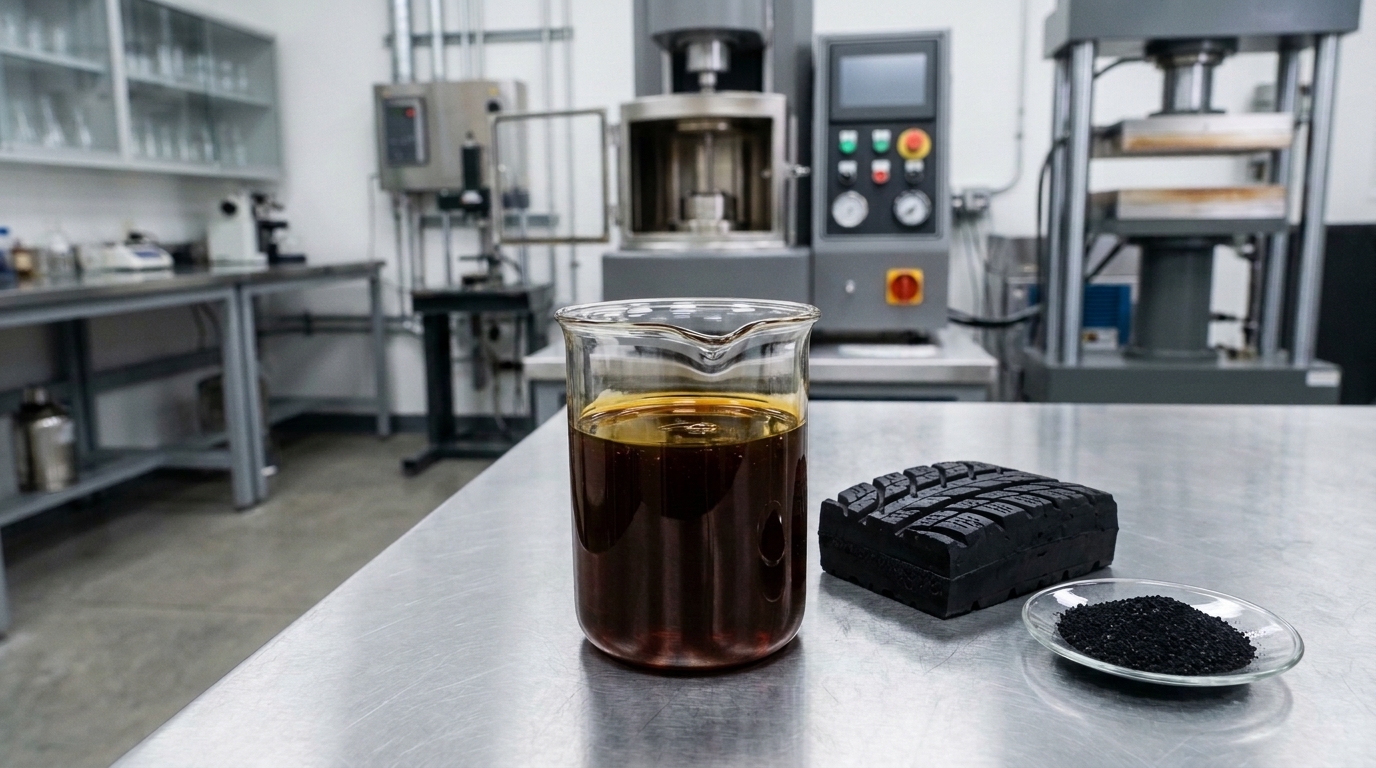
Aromatic Rubber Process Oil
Aromatic process oils contain a high proportion of aromatic carbon ring structures (Ca > 30%), delivering maximum solvency and rapid polymer wet-out for heavily reinforced tyre compounds.
TECHNICAL BENCHMARKS
Elastomer Performance & Specification Matrix
Comparative physical parameters across the three rubber process oil families based on standard ASTM D2226 classification criteria.
| Technical Parameter | Paraffinic RPO | Naphthenic RPO | Aromatic RPO | Significance |
|---|---|---|---|---|
|
Carbon Distribution (ASTM D2140)
ASTM D2140
|
Cp > 65% · Cn < 30% · Ca < 5%
High Paraffinic
|
Cn 35–45% · Cp 45–55% · Ca < 15%
Naphthenic Rings
|
Ca > 30% · Cn 20–35% · Cp 30–45%
Aromatic Core
|
Carbon type dictates polymer solvency vs. thermal oxidation stability |
|
Aniline Point (°C)
ASTM D611
|
95°C – 115°C
High Thermal
|
70°C – 88°C
Balanced
|
35°C – 55°C
High Solvency
|
Lower aniline point indicates higher aromaticity and stronger polymer solvency |
|
Flash Point COC (°C)
ASTM D92
|
≥ 220°C
Low Volatility
|
≥ 200°C
Safe Compounding
|
≥ 210°C
Standard High Flash
|
Ensures safety during high-temperature Banbury compounding and curing |
|
Visual Appearance
ASTM D1500
|
Light golden / straw amber
Light
|
Clear pale amber / honey
Clear Amber
|
Dark viscous amber-brown
Dark Amber
|
Paraffinic and naphthenic grades minimize compound discoloration |
|
Primary Elastomer Fit
Formulation Fit
|
EPDM, Butyl (IIR), TPE, Polychloroprene
Non-Polar Rubbers
|
NR, SBR, BR, Nitrile (NBR), Neoprene
Universal Blend
|
NR, SBR, PBR, Heavy Carbon Black Blends
Tyre Formulations
|
Select process oil based on the chemical polarity of the polymer backbone |
PROCUREMENT WORKFLOW
What Information to Share for an RPO Enquiry
Rubber process oils are selected based on compound polarity, curing temperatures, and physical benchmarks. Sharing these four points enables our commercial desk to coordinate an accurate supply proposal.
Specify RPO Type & Polymer System
Identify whether your compounding formulation requires Paraffinic, Naphthenic, or Aromatic process oil, and confirm your base rubber elastomer.
Define Target Viscosity & Aniline Point
Share your target kinematic viscosity (at 40°C or 100°C), aniline point, and flash point thresholds privately in your quotation request notes.
Request Batch COA & Approved TDS
Our Vadodara team coordinates the current refinery batch Certificate of Analysis, Technical Data Sheet, and Safety Data Sheet for your laboratory team.
Clarify Volume, Packaging & Plant Destination
Provide your estimated volume, preferred packaging (Bulk Road Tankers or 210L Steel Drums), and destination manufacturing facility for direct freight quotation.
Private Specification Matching Protocol
Our technical desk coordinates rubber process oil consignments against your proprietary vulcanization benchmarks. Test standards referenced for private verification include:
TECHNICAL VERIFICATION & TRACEABILITY
Documentation Coordinated on Every Shipment
Industrial material qualification requires rigorous batch traceability. Every commercial consignment is backed by a verified 4-tier documentation package.
Certificate of Analysis
Refinery testing laboratory report for the loading batch detailing verified physical and chemical properties.
Technical Data Sheet
Guaranteed parameter envelope, ASTM/IS test methods, and technical processing guidelines.
Safety Data Sheet
Mandatory 16-section chemical safety dossier covering hazard classifications, exposure, and PPE.
Logistics Clearance
Complete shipping manifest, road transit permits, weighbridge slips, and customs clearance paperwork.
Rubber Process Oil — Parameter Verification
Typical Paraffinic RPO Benchmark
| Parameter | Test Method | Typical Specification | Unit |
|---|---|---|---|
| Kinematic Viscosity @ 100°C | ASTM D445 | 16.0 – 22.0 | cSt |
| Kinematic Viscosity @ 40°C | ASTM D445 | 280 – 350 | cSt |
| Flash Point (COC) | ASTM D92 | ≥ 230 | °C |
| Aniline Point | ASTM D611 | 102 – 112 | °C |
| Pour Point | ASTM D97 | ≤ -6 | °C |
| Carbon Distribution (Cp) | ASTM D2140 | ≥ 66 | % |
Loading-Batch COA Verification: Exact parameter limits for your delivery batch are verified against original refinery release documentation and delivered on your batch Certificate of Analysis.
TECHNICAL QUESTIONS
Rubber Process Oil FAQs
Frequently asked specification, testing, and commercial procurement questions for this product family.
Need plant-specific technical advice?
Our Vadodara commercial and technical desk is available to discuss custom viscosity cuts, solvent formulations, or delivery scheduling.
Contact technical salesState Paraffinic, Aromatic, or Naphthenic along with your rubber compound requirements, approximate quantity, and delivery location.
No. Aromatic Rubber Process Oil is a heavy process oil for elastomer compounding, whereas Aromatic Solvents are light/heavy hydrocarbon solvents for coatings and chemical processing.
Paraffinic RPO suits EPDM, butyl tubes, and UV-stable light goods; Aromatic RPO excels in high-solvency black SBR/BR tyre compounds; Naphthenic RPO balances solvency and low pour point for TPR and footwear.
Batch COAs typically verify kinematic viscosity @ 40°C or 100°C (ASTM D445), carbon type Cp/Cn/Ca (ASTM D2140), aniline point (ASTM D611), COC flash point (ASTM D92), and pour point.
We coordinate both sealed 210-litre steel drums and insulated bulk road tankers dispatched pan-India from our Western India supply corridor.
Yes. Share your plant profile, target RPO type, and estimated monthly tonnage with our Vadodara sales desk to review approved TDS, GHS SDS, and batch COA parameters.
TECHNICAL BUYING GUIDES
Related Guides for Rubber Process Oil
How to Read a TDS and SDS Before Requesting Petroleum Products
Essential guide for industrial procurement officers navigating Certificates of Analysis (COA), Technical Data Sheets (TDS), and 16-section GHS Safety Data Sheets (SDS) for safe batch verification.
Paraffinic, Aromatic and Naphthenic RPO: A Buyer's Introduction
An engineer's breakdown of the three primary Rubber Process Oil (RPO) chemistries—ASTM D2140 carbon distribution, solvency power, elastomer compatibility, and thermal resilience.
CROSS-CATEGORY NAVIGATION
Related Product Families

Base Oils
Global Oil Corporation imports and trades Group I and Group II virgin petroleum base oils for lubricant blenders and industrial formulators across India. Share whether your requirement is Group I or Group II along with your target kinematic viscosity privately in an enquiry.

Aromatic Solvents
Our Aromatic Solvents category brings together named industrial aromatic solvents for coatings, resins, agrochemicals, and chemical processing across India. Note that LAWS (Low Aromatic White Spirit) is listed under Aliphatic Hydrocarbon Solvents.

Request a quotation.
Tell us the product family, quantity, specification, and delivery location to start a focused B2B quotation discussion.